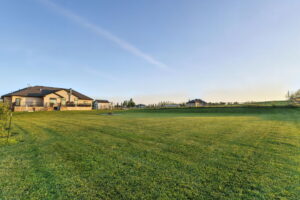

A luxury acreage near Calgary can offer privacy, mountain views, space for horses and a quality of life that is difficult to recreate inside the city. It is also a more complex asset than a conventional urban home.
You are not simply purchasing a residence. You are purchasing land, private infrastructure, legal rights and limitations, and a relationship with the surrounding municipality. A flawless kitchen cannot compensate for an unreliable well, an undocumented septic system or a restrictive covenant that prevents your intended use.
For buyers considering Bearspaw, Springbank, Bragg Creek, Priddis or another country-residential area, these investigations deserve as much attention as the house itself.
1. Read the title—and the documents registered against it
An Alberta land title confirms ownership and identifies registered interests and restrictions. These may include mortgages, liens, caveats and other instruments. The Alberta Land Titles overview explains what a title contains.
Obtaining the title is only the beginning. Your lawyer should review the applicable registered documents, which could include:
Utility rights-of-way and pipeline agreements
Access easements or shared-driveway agreements
Restrictive covenants controlling subdivision, construction or the number of residences
Caveats protecting another party’s claimed interest
Architectural controls or homeowners’ association obligations
A municipal land-use designation may permit an activity while a private covenant still restricts it. This distinction matters if you want to subdivide, add another residence, construct a large shop or keep animals.
Alberta’s Land Titles procedures manual includes separate procedures for easements, caveats, restrictive covenants and utility rights-of-way, illustrating how many different interests can affect rural land.
2. Confirm the zoning for the exact parcel
Do not assume every five-acre parcel carries the same development rights. Permitted uses, discretionary uses, setbacks, building sizes, businesses and animal rules depend on the municipality and the parcel’s land-use district.
Rocky View County’s land-use information notes that activities such as importing fill, adding accessory buildings and operating a home business may require permits or be restricted. Buyers can use the County’s Atlas and land-use maps to locate parcels and review current designations.
If your plans depend on rezoning, do not treat approval as guaranteed. Rocky View County describes redesignation as a public process involving technical review, agency and neighbour circulation, a public hearing and a council decision. County staff cannot predict whether an application will be approved. Review the official redesignation process before assigning value to future development potential.
3. Investigate the water source, not just the tap
Clear, pleasant-tasting water during a showing does not establish that a private well is safe or capable of supporting a household year-round.
Alberta advises that private wells are not regulated like public waterworks. Owners are responsible for maintaining their systems and ensuring their water is safe.
Provincial guidance recommends testing private-well water at least annually for potentially harmful bacteria and completing routine chemical analysis every three to five years. See Alberta’s private drinking-water guidance.
A purchase investigation could include:
The well-drilling report and construction details
Current bacterial and chemical laboratory results
Flow or recovery testing by an appropriate professional
The well’s age, depth, pump and treatment equipment
Historical water quantity during dry periods
Whether the property uses a private well, communal system or water co-op
Agreements, fees and obligations attached to a shared supply
Water quality and quantity are separate issues. Treatment may improve certain quality concerns, but it cannot create an adequate supply where the well’s production is insufficient.
4. Treat the septic system as major infrastructure
A septic system can be largely invisible during a tour, but its condition, capacity and location can affect the residence and future improvements.
Request available permits, designs, installation records, maintenance history and pumping receipts. Have the system evaluated by a qualified professional familiar with its type.
The review should identify the tank, treatment components and disposal field, consider capacity relative to the residence, and look for problems such as surfacing effluent, odour, backups or saturated ground.
Alberta’s private-sewage requirements are governed through provincial safety-code standards and interpretations. The province publishes current private sewage STANDATA for technical guidance and code interpretation.
Location matters as much as condition. A proposed pool, addition, riding arena or outbuilding might conflict with the septic field, reserve area or required setbacks. A functioning system does not necessarily prove that every component was permitted, correctly located or sized for later additions.
5. Verify legal and practical access
A driveway leading to the property does not necessarily prove permanent legal access.
Confirm whether the parcel fronts a public road or depends on a registered easement over neighbouring land. If access is shared, review who must maintain it, how costs are allocated and whether the agreement addresses snow removal, drainage and repairs.
Practical access requires a separate assessment. Consider winter grades, emergency-vehicle access, school-bus routes, gate systems and whether moving trucks or construction equipment can reach the residence. Obtain realistic snow-clearing and road-maintenance estimates for properties with long private approaches.
6. Examine drainage, topography and environmental context
Views and privacy often come from slopes, river valleys and treed sites—the same features that can introduce drainage, erosion, wildfire or access concerns.
Walk the property rather than limiting the inspection to the landscaped area around the house. Review grading, culverts, low areas, retaining walls, slope stability and signs of seasonal water movement. Determine whether significant drainage work, berms or imported fill received the necessary approvals.
Nearby pipelines, utility corridors, flood mapping, resource activity and wildfire exposure may also affect insurance, financing, construction plans and resale value.
7. Reconcile the buildings with the paperwork
Premium acreages often evolve over decades. Previous owners may have added garages, barns, suites, decks, gates, pools or extensive renovations.
Request available development and building permits, inspections, plans, warranties and receipts. Compare the records with what physically exists. An improvement can be beautifully constructed and still create risk if its approval, setbacks or use do not comply.
Specialized systems may also require separate expertise. Geothermal heating, boilers, generators, solar equipment, irrigation and sophisticated water treatment should be assessed by professionals familiar with those systems. A conventional home inspection remains important, but it may not cover every component of a complex acreage.
Make the conditions match the property
An acreage offer should not automatically rely on the conditions commonly used for a city home. Depending on the property, appropriate conditions and document requests may address:
Financing and insurance
Building and specialized-system inspections
Water quality and quantity
Septic-system condition
Title and registered documents
Municipal permits and compliance
The buyer’s intended uses
The objective is not to make every acreage appear risky. It is to distinguish a well-documented property from one whose unresolved questions should affect the conditions, price or decision to proceed.
Before falling in love with the view, build a due-diligence plan around the land and the systems supporting it. Gordyn Matheson Real Estate can help buyers evaluate Calgary-area acreages, organize property-specific investigations and negotiate with a clearer understanding of value and risk.
Call Gordyn Matheson Real Estate at 403-918-8881 or email gordyn@gordynmatheson.com for a confidential acreage-buying conversation.
This article provides general information as of September 14, 2026. It is not legal, engineering, environmental, water-quality or inspection advice. Requirements vary by property and municipality. Consult the appropriate lawyer, lender, municipality and qualified technical professionals before making a binding decision.